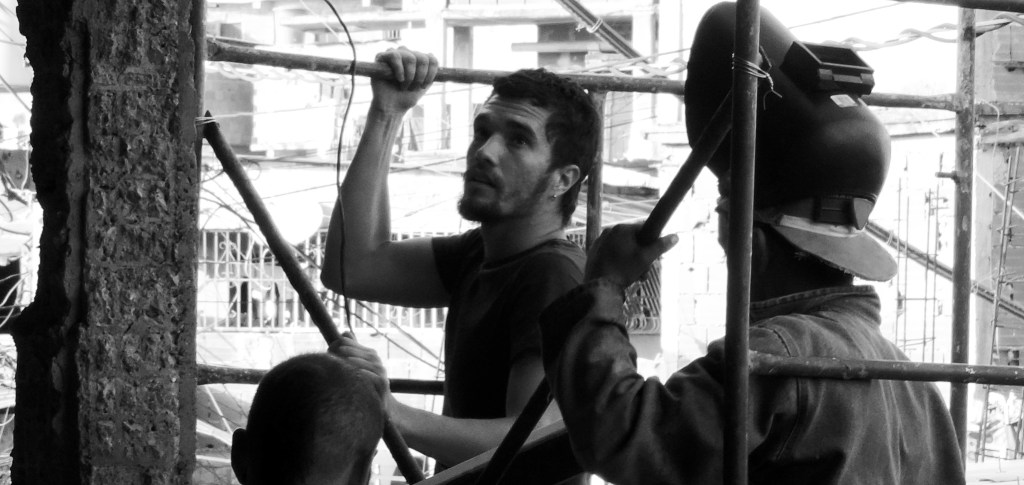
Marcos Coronel is an architect who graduated from the Central University of Venezuela. He is a specialist in Social Habitat and Development at UN-Habitat.
He is co-founder of PICO, a collective that works on physical transformation interventions in favelas and pushfull communities.
In 2011 he built his first project, a requalification of the standard typology of state single-family housing, based on the reformulation of local materials and techniques.
From this moment on, he manages to develop several infrastructures and social facilities in popular settlements in Venezuela and the world.
In this period, he has guided, designed, and built multiples projects alongside civil organizations and institutions.
As a professor and guest lecturer, he has taught at the Ecole Nationale d’Architecture Paris Val de Seine, School of Architecture of the University of Talca, Faculty of Architecture and Planning of the National University of Rosario, University Veritas, FAU University of Chile, and in Manchester School of Architecture.
Resident Artist of the XX Havana Biennial of Art 2015; Instituto Do It Yourself, Madrid 2017; XVI Latin American Social Workshop, Costa Rica 2019; and at the X International Meeting of Collective Architectures, Canary Islands 2017.
Honors and recognitions for his projects include the Curry Stone Design Prize, taking part in the Social Design Circle, among the 100 most relevant social design practices in the world, USA 2017. Award for Social Production of the Habitat -Architecture Sans Frontieres International Awards 2015-, and the First Award of the World Social Habitat and Development confrontation contest of the 2016 Pan American Architecture Biennial of Quito. His work was shortlisted for the Royal Academy Dorfman Award, London 2020.
In 2018 he received the Young Architect In Latin America Award at the Venice Biennale. In the same year his project -Community facilities system- was nominated to the Oscar Niemeyer for Latin American Architecture Award.
_
Marcos Coronel es un arquitecto graduado de la Universidad Central de Venezuela. Especialista en Hábitat Social y Desarrollo de ONU-Hábitat.
Es cofundador de PICO, un colectivo que trabaja en intervenciones de transformación física en barrios y comunidades.
En 2011 construye su primer proyecto, una recalificación de la tipología estándar de vivienda unifamiliar estatal, basada en la recolocación de materiales y técnicas locales.
Su trabajo en asentamientos populares, lo ha llevado a desarrollar proyectos de espacios cívicos y culturales, estructuras que integran naturaleza, energías y economías culturales en atmosferas de comunidad.
Como profesor y ponente, ha impartido clases en la Ecole Nationale d’Architecture Paris Val de Seine, 2020; Escuela de Arquitectura de la Universidad de Talca, 2018; Facultad de Arquitectura y Planificación de la Universidad Nacional de Rosario, 2017; Universidad Veritas, 2019; Universidad FAU de Chile, 2019; en Manchester School of Architecture, 2018; y en el Tecnológico de Monterrey, 2016.
Artista Residente de la XX Bienal de Arte de La Habana 2015; Residente del Instituto Do It Yourself, Madrid 2017; en el XVI Taller Social Latinoamericano , Costa Rica 2019, y del X Encuentro Internacional de Arquitecturas Colectivas Islas Canarias, España 2017.
Premio Curry Stone Design Prize (USA) 2017. Premio a la Producción Social del Hábitat Architecture Sans Frontieres International Awards 2015; Premio de Hábitat Social y Desarrollo en el Concurso de Confrontación Mundial de la Bienal Panamericana de Arquitectura de Quito 2017 con el proyecto Sistema de Equipamientos Comunitarios, una rehabilitación integral de un barrio desbordado dentro del Parque Nacional Waraira Repano de Caracas. Premio CAF de Desarrollo Urbano e Inclusión Social en América Latina 2018. Fue nominado al Premio Royal Academy Dorfman, Londres 2020.
En 2018 recibe el premio Young Architect In Latin America en la Bienal de Arquitectura de Venecia. El mismo año fue nominado al premio Oscar Niemeyer a la Arquitectura Latinoamericana.
 Marcos Coronel